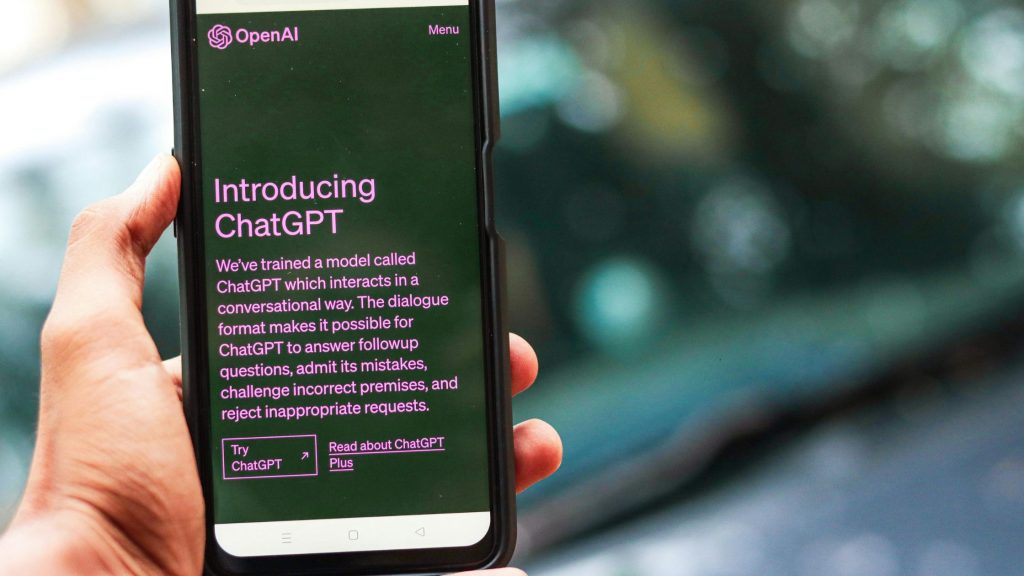
In 2026, web users are increasingly asking conversational tools, like ChatGPT, for a single, complete answer — and treating that answer as the starting point for decisions, not just information. ChatGPT is no longer a niche productivity tool. In fact, it reached over 100 million weekly active users within its first year and continues to grow as OpenAI expands access globally. It’s becoming a mainstream interface for discovery: learning, planning, comparing options, and making purchase decisions inside the conversation. OpenAI’s own research now frames ChatGPT as a global consumer product at enormous scale (and growing especially fast in lower-income countries).
So the question “Are ads coming to ChatGPT?” has shifted from hypothetical to inevitable.
OpenAI has now publicly outlined an advertising approach tied directly to access: keeping a meaningful free experience available, while giving people a lower-cost tier with expanded usage. In OpenAI’s words, the goal is broad availability of a “personal super-assistant”, and the company explicitly links advertising to expanding that access.
But this isn’t “banner ads in a chatbot”. The direction OpenAI is signalling is closer to: high-intent, context-driven sponsored placements that appear when relevant, and don’t interfere with the actual answer. Their stated priority is preserving trust — because people already rely on ChatGPT for personal and important tasks.
That trust point is the crux for marketers. If ChatGPT becomes a primary place people ask “what should I buy?”, “which provider is best?”, “what’s the right option for me?”, then ChatGPT advertising won’t just be another channel. It will reshape the funnel — because the funnel is happening inside the interface.
And the scale indicators are hard to ignore. Independent analysis of web traffic suggests monthly visits to chatgpt.com more than doubled year-on-year between August 2024 and August 2025 (while google.com traffic stayed relatively flat). That’s exactly the kind of behavioural shift that tends to precede a new ad market.
This guide breaks down what’s been announced, what it likely means for ChatGPT ads and ChatGPT search ads, how it may compare to Google/Meta-style advertising, and what brands can do right now to show up in ChatGPT without paying.
Why OpenAI Is Even Considering Ads (And Why the Timing Makes Sense)

OpenAI’s public framing is not “we need ad revenue”. It’s “we want more people to have access to this level of capability.”
In its ChatGPT advertising announcement, OpenAI describes AI as reaching a point where “everyone can have a personal super-assistant” — and argues that who gets access will shape whether AI expands opportunity or reinforces existing divides. That’s the philosophical layer. The practical layer is cost.
Frontier AI is expensive to run. Compute, infrastructure, and ongoing development have real unit economics — and OpenAI is scaling a product used globally, daily. It was recently reported that OpenAI’s CFO saying annualised revenue exceeded $20bn in 2025, alongside major increases in computing capacity — a reminder that OpenAI is building for scale, and scale needs a durable business model.
That’s where a mixed revenue model starts to make sense:
- Subscriptions for people and organisations that want premium capability without ads
- Advertising to keep entry-level access viable for a large mainstream user base
OpenAI has also been explicit about who ads are for (at least initially). Ads are tied to its Free and low-cost tier strategy — notably ChatGPT Go, a cheaper subscription positioned between Free and Plus. ChatGPT Go launched in 171 countries and is priced at $8/month.
And crucially, OpenAI has said ads won’t appear for higher paid tiers: Pro, Business, and Enterprise are expected to remain ad-free.
That decision matters for brand perception. It signals OpenAI wants ads to be an access lever, not the core product experience.
It also hints at how advertising on ChatGPT may evolve:
- Early testing will likely focus on sponsored products/services aligned to the conversation
- Placements are expected to be clearly labelled and separated from the organic answer
- OpenAI emphasises that ads should not influence the answers users receive (a stated “answer independence” principle)
From a marketing perspective, the timing is logical. If ChatGPT is increasingly used for research and recommendations (mid-funnel), then a relevant sponsored placement at the moment of intent could be highly efficient — potentially closer to “assisted decision-making” than classic search ads.
In other words, ChatGPT marketing isn’t just about getting seen. It’s about being present at the exact moment a user is trying to decide.
What Has ChatGPT Actually Announced About Advertising So Far?
At this stage, it’s important to be precise. ChatGPT advertising has not fully launched, and OpenAI has been careful to avoid over-promising or rushing monetisation. What has changed is that advertising is now officially on the roadmap — with clearly defined guardrails.
OpenAI has confirmed that it plans to begin testing ads in the United States for logged-in adult users on its Free and Go tiers, ahead of any wider rollout. Higher-tier plans — Pro, Business and Enterprise — will remain ad-free.
“We’re not launching ads yet, but we do plan to start testing in the coming weeks for logged in adults in the U.S. on the free and Go tiers.”
This framing matters. Rather than a blanket rollout, OpenAI is signalling:
- Controlled testing
- Limited inventory
- Heavy emphasis on user feedback
That’s very different from the early days of Google or Meta advertising, which scaled rapidly once the switch was flipped.

Where will ChatGPT ads appear?
OpenAI has been unusually specific about initial placement. And this is likely because Bain research found that 80% of consumers rely on “zero-click” answers for at least 40% of their searches, signalling growing trust in AI-generated summaries over traditional link-based results. Ads will not interrupt the core answer. Instead, they are designed to sit after the response, and only when relevant.
“To start, we plan to test ads at the bottom of answers in ChatGPT when there’s a relevant sponsored product or service based on your current conversation.”
Key points worth underlining for marketers:
- Ads are contextual, not keyword-triggered in the traditional sense
- They are clearly labelled and visually separated from organic answers
- They appear only when a commercial option genuinely fits the query
This is a deliberate attempt to avoid undermining trust — which OpenAI repeatedly frames as its most valuable asset.
What will not be allowed (at least initially)?
OpenAI has also outlined explicit exclusions designed to reduce risk and regulatory pressure during early testing:
- Ads will not be shown to users under 18 (based on declared or inferred age)
- Ads will not appear near sensitive or regulated topics, including:
- Health
- Mental health
- Politics
This instantly narrows the early advertiser pool — but it also reinforces the message that ChatGPT search ads are intended to be assistive, not exploitative.
Early examples of ChatGPT ad formats
To help set expectations, OpenAI has shared example mock-ups rather than leaving the industry guessing.
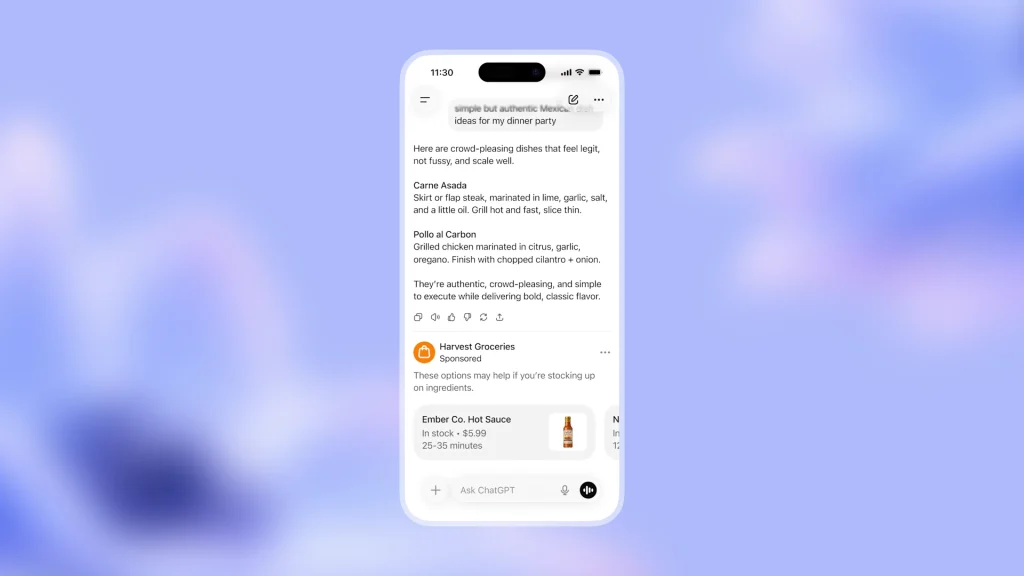
One example shows a conversational response about hosting a Mexican dinner party, followed by a clearly labelled sponsored product recommendation for a hot sauce — presented in a clean, unobtrusive card format.
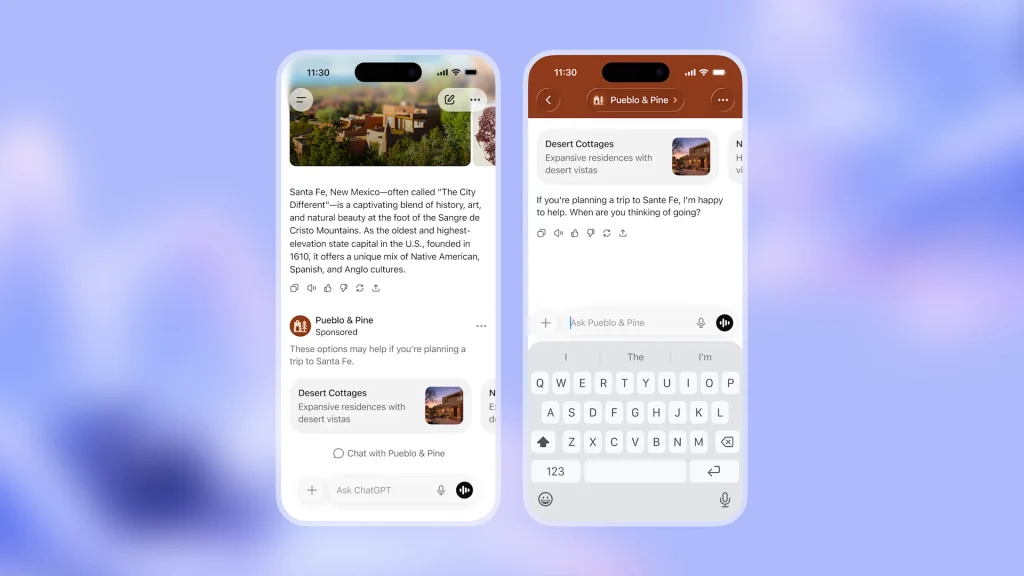
Another example shows a conversation about travelling to Santa Fe, New Mexico, with a sponsored accommodation listing appearing below the informational answer, plus the option for the user to continue asking questions directly about that sponsored option.
These examples hint at a broader strategic shift: ads as part of the conversation, not a distraction from it.
OpenAI’s Advertising Principles (And Why They Matter to Brands)
Before talking costs, formats or competition, OpenAI has been keen to establish the rules by which its advertising model will operate. These principles aren’t marketing fluff — they’re central to how ChatGPT advertising is expected to differ from existing platforms.
Understanding them is crucial for any brand considering advertising on ChatGPT in the future.
Ads as an access enabler
OpenAI explicitly positions advertising as a way to expand access to AI, not replace subscriptions or distort incentives.
“Our mission is to ensure AGI benefits all of humanity; our pursuit of advertising is always in support of that mission and making AI more accessible.”
From a commercial perspective, this signals restraint. Ads are not being optimised for maximum volume or time-on-platform — they’re being positioned as one revenue stream among several.
For advertisers, that likely means:
- Fewer placements
- Higher relevance thresholds
- Slower scaling
But potentially higher trust and attention.

Answer independence: You can’t buy the answer
This is perhaps the most important principle for credibility.
“Ads do not influence the answers ChatGPT gives you. Answers are optimized based on what’s most helpful to you.”
In practical terms, this means:
- Sponsored placements sit outside the answer
- Brands cannot pay to be recommended as “the best”
- Organic relevance and authority still matter
This is a fundamental departure from traditional search ads, where paid placements sit alongside (and often above) organic results in the same visual hierarchy.
For marketers, it also means ChatGPT marketing is not a shortcut around authority. Paid visibility may complement presence — but it won’t replace it.
Conversation privacy: No data selling
Privacy is where OpenAI draws one of its hardest lines.
“We keep your conversations with ChatGPT private from advertisers, and we never sell your data to advertisers.”
That has major implications for targeting:
- No access to raw conversation data
- No third-party audience pools built from chat history
- Targeting is driven by context, not behavioural profiles
Compared with Meta’s or Google’s data-rich ecosystems, this represents a more constrained — but arguably more ethical — ad environment.
Choice and control for users
OpenAI also emphasises user agency:
“You control how your data is used. You can turn off personalization, and you can clear the data used for ads at any time.”
Crucially, users will always have a route to an ad-free experience via paid tiers. This reduces resentment and helps preserve trust — something many platforms lost once ads became unavoidable.
Long-term value over short-term revenue
Finally, OpenAI is explicit about its optimisation goals:
“We do not optimize for time spent in ChatGPT. We prioritize user trust and user experience over revenue.”
This single statement explains why ChatGPT ads are likely to feel very different from:
- Infinite scroll social ads
- Click-bait search ads
- Retargeting loops
From a brand perspective, it suggests a smaller but higher-quality opportunity — one where relevance and usefulness matter more than creative trickery.
What Will ChatGPT Ads Look Like? (Ad Formats Explained)
One of the most common questions around ChatGPT ads is also the simplest: what will they actually look like?
Based on OpenAI’s own announcements and early mock-ups, the answer is clear — ChatGPT advertising is not designed to resemble traditional search or social ads. There are no banners, no sidebars, and no competing blocks fighting for attention. Instead, ads are designed to feel contextual, assistive and conversational.
Sponsored product and service recommendations
The first ad format OpenAI plans to test is a sponsored recommendation card that appears after ChatGPT has delivered its organic answer.
These placements:
- Sit at the bottom of the response
- Are clearly labelled as sponsored
- Are only shown when there is a relevant commercial match
For example, in OpenAI’s own demonstration, a user asking for ideas for an authentic Mexican dinner party receives a full, helpful answer first — followed by a clearly marked sponsored product recommendation for a hot sauce that fits the context.
This placement strategy is deliberate. By keeping the ad outside the answer itself, OpenAI reinforces its “answer independence” principle, while still allowing brands to appear at a high-intent moment.
From a marketer’s perspective, this format behaves less like classic PPC and more like assisted discovery — appearing only when the user is already receptive.
Sponsored listings within planning and discovery journeys
Another format OpenAI has previewed is especially relevant for sectors like:
- Travel and accommodation
- Local services
- SaaS and subscriptions
- High-consideration consumer products
In a travel-planning example, ChatGPT provides an informational overview of visiting Santa Fe, New Mexico, then surfaces a sponsored accommodation listing for a relevant property — again, clearly labelled and visually separated.
What’s different here is what happens next.
The user can continue the conversation by asking follow-up questions about the sponsored option:
- Availability
- Suitability
- Features
- Comparisons
This is where ChatGPT search ads diverge sharply from Google Ads. The ad isn’t just clicked — it becomes part of an ongoing dialogue.
As OpenAI has put it:
“Conversational interfaces create possibilities for people to go beyond static messages and links.”
For brands, this suggests a future where ads are less about copywriting tricks and more about answering real questions well.
Interactive and conversational ads (future direction)
Looking further ahead, OpenAI has hinted at a new category of advertising entirely: ads you can talk to.
“Soon you might see an ad and be able to directly ask the questions you need to make a purchase decision.”
This is arguably the most disruptive part of ChatGPT marketing.
Instead of:
- A headline
- A description
- A landing page
You get:
- A conversation
- Dynamic clarification
- Real-time qualification
For complex purchases, this could significantly reduce friction — and compress the funnel.

How Much Will Advertising on ChatGPT Cost?
At the time of writing, OpenAI has not announced pricing for ChatGPT ads — and that uncertainty is intentional.
Rather than launching with a fully defined auction model (as Google did), OpenAI is taking a test-and-learn approach, prioritising:
- User experience
- relevance
- advertiser usefulness
That said, we can make some educated assumptions based on what has been announced — and how similar platforms have evolved.
Likely pricing models
Early advertising is expected to test one or more of the following:
- Cost-per-click (CPC)
Paying when a user engages with the sponsored placement - Cost-per-action (CPA)
Paying for defined outcomes, such as sign-ups or purchases - Affiliate or commission-based models
Particularly for ecommerce, travel and bookings
Given OpenAI’s emphasis on usefulness and relevance, performance-based pricing is likely to play a larger role than impression-heavy CPM models.
Will ChatGPT ads be expensive?
Initially, they probably will be — for three reasons:
- Limited inventory
Ads only appear in relevant contexts, not across every query - High intent
Users asking questions inside ChatGPT are often mid- or bottom-funnel - Low competition (at first)
Early access is likely to be restricted to a small number of advertisers
However, “expensive” needs to be viewed differently here. If ChatGPT marketing delivers fewer impressions but higher conversion rates, the overall ROI could still outperform broader, noisier channels.
In other words: ChatGPT ads are likely to trade scale for quality.

ChatGPT Ads vs Google Ads, Bing Ads and Meta
To understand where ChatGPT fits into the advertising ecosystem, it helps to compare it directly with existing platforms.
At a high level, the difference comes down to intent and mindset.
Traditional platforms
- Google Ads capture declared intent via keywords
- Bing Ads operate similarly, with smaller scale
- Meta ads focus on discovery and interruption
These platforms work well — but they rely on:
- Multiple results
- Competing messages
- User filtering
ChatGPT ads
ChatGPT flips that model.
Instead of:
- “Here are 10 links — choose one”
It offers:
- “Here’s the answer — and here’s a relevant option if you want to go further”
Key differences include:
- Conversational intent rather than keyword intent
- One primary answer, not a results page
- Contextual relevance, not audience profiling
- Trust-first design, rather than engagement maximisation
From a funnel perspective, ChatGPT ads are likely to sit somewhere between:
- Google Search (high intent)
- and human recommendations (high trust)
That combination is rare — and potentially very powerful. Especially when early studies show that when AI Overviews appear in Google Search, organic click-through rates fall by up to 34%, while paid CTRs also decline as users get answers without clicking.
How to Appear on ChatGPT Without Advertising
One of the most misunderstood aspects of the current conversation around ChatGPT advertising is the assumption that paid ads will replace organic visibility. Based on everything OpenAI has said so far, that’s unlikely.
In fact, OpenAI has been explicit that ads do not influence answers. That means brands will continue to appear (or not appear) in ChatGPT responses based on authority, relevance, and clarity — not ad spend.
This is where AI Optimisation (often referred to as AIO or AI SEO) becomes critical.
Why brands already appear in ChatGPT answers
ChatGPT draws from a wide ecosystem of trusted sources and signals, including:
- Well-structured, authoritative websites
- Recognised brands and entities
- Content that clearly answers questions
- Sources that are widely cited across the web
In practice, this means:
- If your brand consistently publishes clear, useful, verifiable content
- If that content is easy for AI systems to interpret and reference
- And if your brand is reinforced across the wider web
You can already gain visibility without paying.
AI Optimisation (AEO) as a foundation, not a workaround
Multiple studies have found that the majority of sources cited by AI search tools still come from page-one Google results, especially the top 3–5 positions. This is why AEO shouldn’t be framed as an “alternative” to ChatGPT ads — but as the foundation underneath them.
Strong AI visibility helps:
- build trust before paid placements exist
- reduce reliance on advertising long-term
- improve the effectiveness of future paid campaigns
At Big Star Digital, AEO is treated as a natural evolution of search strategy — combining technical SEO, content design, entity optimisation and off-site authority signals to improve how brands appear in AI-generated answers. The brands that benefit most from ChatGPT marketing in the future are likely to be the ones that are already useful to AI systems today, and our AEO services are an effective first step to success in this department.
Frequently Asked Questions
Are ChatGPT ads live yet?
No. Ads are not fully launched. OpenAI has announced limited testing for logged-in adult users in the U.S. on Free and Go tiers.
Can brands pay to influence ChatGPT answers?
No. OpenAI has stated that ads do not affect answers, which are optimised based on what is most helpful.
Will ChatGPT sell my data to advertisers?
No. OpenAI has explicitly stated that conversations are kept private and are not sold to advertisers.
Will small businesses be able to advertise on ChatGPT?
Potentially, yes. OpenAI has highlighted that ads could help smaller and emerging brands compete — though access is likely to be limited during early testing.
When will ChatGPT ads roll out globally?
No global timeline has been announced. Wider rollout will likely depend on test performance, user feedback and regulatory considerations.
What Brands Should Be Doing Now
The biggest mistake brands can make is waiting for ads to launch before taking action.
Right now, the smartest steps are:
- Investing in AI-friendly, answer-first content
- Strengthening brand authority and entity signals
- Ensuring technical SEO fundamentals are solid
- Experimenting with AIO alongside traditional SEO
- Treating AI search as a core discovery channel, not an edge case
Even if you never run ChatGPT ads, these steps improve visibility across:
- AI assistants
- AI Overviews
- Next-generation search interfaces
And if you do advertise in the future, they make paid placements far more effective.

Preparing for the Next Era of Search Advertising
ChatGPT ads are coming — but not in the way many marketers expect. They won’t be loud. They won’t be manipulative. And they won’t reward brands that rely purely on spend.
Instead, ChatGPT marketing will favour brands that are:
- Genuinely useful
- Contextually relevant
- trusted by both users and AI systems
At Big Star Digital, we’re already working with brands to prepare for that reality — through AI Optimisation today, and AI Ads Management as these platforms mature.
If you want to:
- Future-proof your search strategy
- Understand how AI is reshaping visibility
- Be first in line when new ad opportunities open
Get in touch to discuss our AI services and sign up to our newsletter for early access to AI Ads updates.